Reflections of our Mission to Israel During Time of War
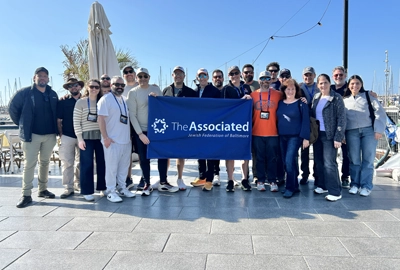
We were tempted to start this blog with how our trip ended, but doing so would overshadow what we’ll genuinely carry with us from our time in Israel. Yes, we evacuated a war zone, and yes, we are all still processing our experiences. But the Nachalah 2026 men’s mission to Israel should be defined by the unbreakable bond formed among the 12 of us and our two incredible professional leaders from The Associated, Stephanie Kohler and Brooks Walter, and what we will bring back to share with our Baltimore community.
This bond was partially formed through our unique journey home, but more so by our unique cultural experiences in Israel and bearing witness to a country still recovering from two plus years of its own trauma, yet somehow still brimming with gratitude and hope.
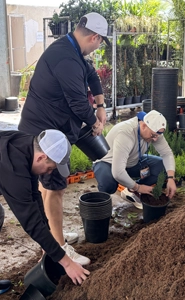
For most of us, this was our first time in Israel since October 7th and for several our first time in Israel, period. On our first full day in Israel, we met Ohad and Raz Ben Ami. Ohad was held hostage by Hamas for nearly 500 days, and his wife Raz for over 50 days. Despite being held in unimaginable conditions, for well over a year-and-a-half, Ohad is grateful. Grateful for a new lease on life, and grateful that we heard and will share his and Raz’s stories. Ohad became a surrogate father to the young men with whom he was held captive in a nearly suffocating tunnel deep below the ground in Gaza. Watching celebratory videos of Ohad and his “sons” reuniting after their release, brought with it such a wide range of emotions that we will never forget.
Unfortunately, not every story we witnessed ended in celebration. We wept with Eden Gez’s family at the Forrest of the Fallen in Ashkelon. Eden, a beautiful, 31-year-old woman, the life of the party with an endless smile, was brutally murdered while driving away from the Nova festival. Hearing her story became one of the most impactful and, oddly, healing moments of the trip. Eden’s sister and father, through their tears (and ours), thanked us for being there, for hearing and carrying forward her story.
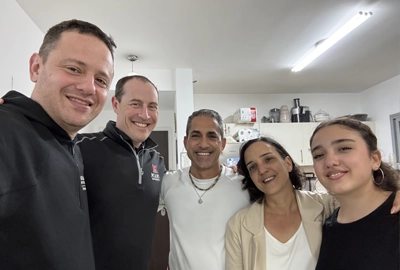
At that moment, it clicked: bearing witness isn’t about unnecessary exposure to pain but rather witnessing the ability to offset tragedy with hope and gratitude that is uniquely Israeli. Everyone we met thanked us for being there and asked us about our experience with rising antisemitism in the U.S. This outward focus, even with so much happening at home, is the bond that unites us.
The trip wasn’t all heavy. One night in Ashkelon, we split up into small groups for a home hospitality dinner with local families in Baltimore’s partner city, giving us the opportunity to wade into every taboo topic involving Israel in a congenial environment. At one of these dinners, we asked our host family if they ever think about relocating, given everything going on in Israel and how close they live to Gaza. Our host family answered in the most beautifully Israeli way possible. With a perfect and profound rhetorical question followed by a deeply meaningful truth: “Why would we leave? This is our home.”
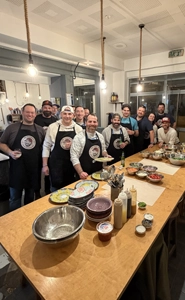
We also tasted whiskey and star gazed (more of the former than the latter) inside of the Mitzpe Ramon “maktesh” (translated as crater, but it was created by erosion). Another amazing evening included a cooking class dinner in the Ha Carmel market in Tel Aviv followed by drinks and award-winning Israeli pizza at a Tel Aviv hot spot. Yes, we had two dinners. Don’t judge. We also spent Friday afternoon fully immersed in the Machne Yehuda market in Jerusalem, many of us wrapping tefillin, eating our way through the Shuk and snapping up souvenirs as the perfect precursor to Shabbat.
Even though our trip would take a sharp turn less than 18 hours later, we were living our best Israeli lives that Friday. We gathered arm in arm for a wonderful Kabbalat Shabbat at the Kotel where we discussed our Shabbat traditions at home and our hopes for how we would enhance them upon our return.
We understand the interest in how we got out of Israel quickly and safely when so many others were (or still are) stuck. Long story short: quick thinking, masterful planning and eminent professionalism from The Associated, JFNA, Kenes (our travel agency in Israel) and Dakkak (our travel agency in Jordan).
The first rocket siren went off at approximately 8:13 a.m. on Shabbat morning. We all went to the mamads on the floors of our hotels. They were cramped but sufficient. Once we got the all-clear WhatsApp message from our security guard, we left the shelters and convened at a room that became our home base for the next day. Given the frequency of the sirens, many of us decided to sleep on “minus 4,” as we called it (i.e., 4 floors underground). Just a few hours after that first siren, we were on a Zoom with The Associated and Kenes to discuss the plan for evacuating Israel. Many of us were uncertain, but we were encouraged to decide on a course of action quickly. That speed mattered. We secured some of the last seats on the flight from Amman, Jordan to Chicago two days later. Not only did we reserve our seats, but Jordanian airspace partially closed the evening after we left. Had we not been supported to act decisively, we may have been separated from our families much longer.
On Sunday morning, we drove from our hotel in Jerusalem two hours Northeast to the terminal crossing, through the West Bank. We were briefed on actions to take when rocket sirens went off during our journey. Lying face down on the side of the road with your now closest friends waiting for danger to pass was unnerving, but we survived and even have some funny pictures for posterity.
We got to the border crossing, waited for our turn for our bus to be let through and entered passport control station number one. After a few of us scanned our passports, another rocket siren went off. We rushed outside to the shelters, but there wasn’t enough room given the number of people at the crossing. We got on the ground, again, and saw and heard the rockets followed by the beautiful Iron Dome in action.
Once we got the go ahead, we proceeded to the second passport control station. A quick bus ride across the border followed, where we were then able to pick up our own bus to Amman. We arrived at a beautiful hotel in Jordan’s capital, unloaded and made our way to our rooms.
Then came the sirens again. Jordanian hotels don’t have shelters, so the safest place is the interior hallways. We had a wonderful dinner together, tried to get some sleep and woke up early the next morning to eat a quick breakfast and depart for the airport. We got to the airport, having picked up our “expediter” along the way to smooth our path through Jordanian immigration and security.
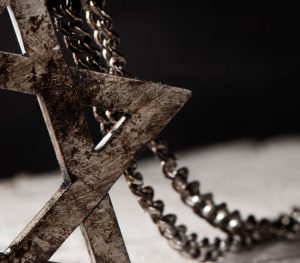
One of the harder aspects of leaving through Jordan was leaving our Judaica behind in Israel. We mailed home necklaces we never typically take off, yarmulkes, Tefillin, clothing and anything else that could identify us as Jews. Our land agent, guide and security guard suggested doing so to ensure safe, uninterrupted passage through Jordan. We knew it was good advice, but piling up all signs of our Jewish identities in the middle of the room left bitter tastes in our mouths.
Our cohort consists of some of the proudest Jews and most ardent Zionists you’ll ever meet. We didn’t want to take this step, but we knew this was the least frictional path back to our families.
At takeoff, one of our trip members snapped a picture of what looked like a rocket that had hit the ground in the distance. We took off to the south, flew over Egypt and then turned west to head home. Finally, 13 hours later, we landed in America. We scarfed down burgers and drinks; in disbelief we had gotten back safely. With our flight delayed, we landed at BWI around 1:00 a.m.
Although we were fortunate to get home safely, we felt a definite sadness about our departure. Sadness that we didn’t get to experience our full trip, sadness that we were leaving behind our Israeli friends that took incredible care of us and kept us safe, and a sadness knowing that having to leave because of the war would, as hard as we would try, at least somewhat shape our experience.
We’re often asked if we’ll be going back to Israel. This is one of our favorite questions. Not only are we both going back, but we’re going back together. Our families signed up for The Associated 2026 Family Mission in December. While we certainly understand trepidation, here’s the truth: there always will be a reason to delay a trip or to not go at all and we want to go back. We want to go home.
Subscribe to our newsletter
The Associated is a home for everyone in the Baltimore Jewish community. We offer several email lists to help people find a community, engage with their peers and support Jewish journeys around the world.
Join Our Mailing List

Add Impact to Your Inbox
Sign up for our newsletter
Subscribe to our newsletter
The Associated is a home for everyone in the Baltimore Jewish community. We offer several email lists to help people find a community, engage with their peers and support Jewish journeys around the world.
Join Our Mailing List

 Please Wait while we loading your video.