Meet Rebecca Krasner

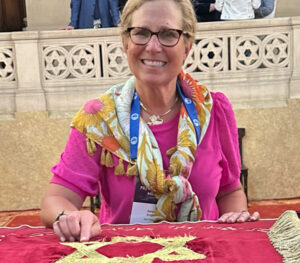
New York native, Rebecca Krasner, is passionate about her new role as executive director of The Associated’s Center for Counter Antisemitism and Hate. Having arrived from Philadelphia, where she was the director of education at the Weitzman National Museum of American Jewish History, she is committed to building strong community partnerships and combating antisemitism through relationship building, storytelling and education.
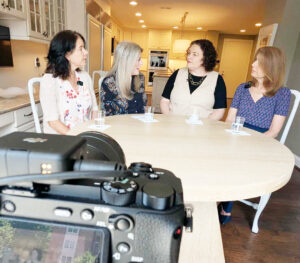
We sat down with this mother of four, whose husband, Abe Friedman, is interim rabbi at Beth El Congregation, to learn more about her background and her vision for this new Center.
Tell us about your museum work countering antisemitism.
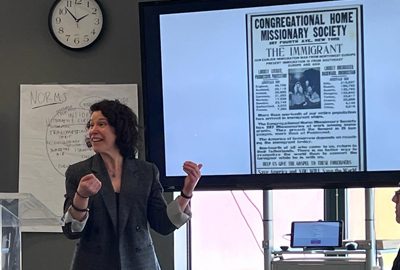
The museum’s permanent collection was shaped in the 90s, when antisemitism in America wasn’t at the forefront of our conversation. Yet the environment began to change, even before October 7, and we started rethinking how to teach about and interpret the museum’s collection to more explicitly emphasize antisemitism.
These discussions started around 2017, after the white supremacist Unite the Right rally in Charlottesville, Virginia followed by the 2018 massacre at the Tree of Life synagogue in Pittsburgh. While we had many artifacts that told the story of historic antisemitism in America, none of the objects in collection told the stories of current day antisemitism.
In 2022 the museum acquired the cup and chair from the Colleyville, Texas synagogue hostage crisis. With that acquisition, we could both tell the history of antisemitism in America and its contemporary manifestations.
Fast forward to October 7, when the need for education and programming about antisemitism and the Jewish people became urgent.
What was this educational program?
In the education department, we leaned into our role as a national destination and content provider for public and independent schools. The museum welcomes close to 10,000 school children each year and provides professional development to 1,000 teachers annually. We demystified what it means to be Jewish and amplified stories of individuals who represent a broad spectrum of Jewish identity, geographic location, race and religious expression.
We also redesigned our in-person school programs to include an introduction to the history of the Jewish people, emphasizing the indigeneity of Jews to Israel and that Jewish people live and have lived across the globe including in places such as Africa, Asia and The Middle East. the world feels a connection to one another, to our history, Israel and our faith. The Weizman emerged as a leader in confronting antisemitism in K-12 schools and created a website with free curricular lesson plans and materials called Stories That Shaped a Nation: Jewish Lives in America.
You mention the diversity of the American Jewish community as a way to counter antisemitism.
There is a misperception that Jews are wealthy, white people who have not experienced oppression. We wanted to highlight the diversity of the Jewish people, the history of persecution, and the theme of resilience and allyship. We need to challenge these narratives and educate both Jews and non-Jews about who we are and our values.
What brought you to Baltimore to head this new Center?
I love the idea of building something proactive, not just reactive. We have the chance to harness the power of The Associated network and build a coalition to not just focus on addressing antisemitic incidents, but also educating and deepening understanding of the Jewish experience. In both the Jewish and non-Jewish community. We also want to create opportunities for Jews to feel proud of their Jewish heritage and culture.
What are the Center’s goals?
The Associated’s Center for Countering Antisemitism and Hate proactively combats anti-Jewish hate to protect and strengthen our community.
The Center leads strategic action, elevates, scales and expands the capacity of our agencies, establishes impact metrics to evaluate progress and devlops new strategies and initiatives in four areas of focus: education, safety and security, coalition and bridge building and empowering our Jewish community.
So, what are your plans?
We are focused on four pillars. This includes:
- Education: Building a K-12 strategy that supports parents, deepens relationships between administrators and education leaders, provides teachers with high quality resources and empowers Jewish students in their school settings. We will also address education on our college campuses.
- Safety and Security: Keeping our community safe is critical, and we need to continue to invest in state-of-the-art security. Unfortunately, it’s the reality of how we live today. And it costs a lot of money.
- Empowering our Jewish Community: Providing them with the tools, education and confidence to stand up to antisemitism and feel secure and proud expressing their Jewish identity.
- Coalition and Bridge Building: We hope to foster understanding between the Jewish and non-Jewish community by listening to one another, sharing experiences and engaging in honest conversation. These connections not only break down misconceptions but also create a foundation of empathy and trust that strengthens all of us.
Have you or your family ever experienced antisemitism?
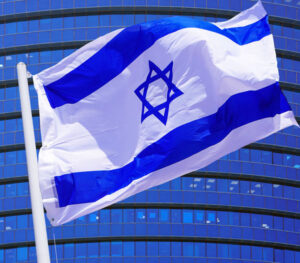
Shortly after October 7, when we were living in Philadelphia, we hung an Israeli flag on our second story window. It kept getting torn down, and we kept putting the flag back up. We also hung hostage posters from the window boxes of our home, which also got taken down, graffitied, and erased.
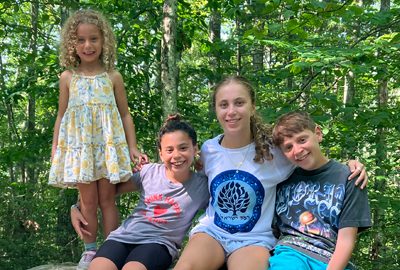
My son, meanwhile, experienced antisemitism when he was leaving our home one Saturday morning for synagogue. He was wearing a kippah and walked out of our home with the big Israeli flag and hostage posters. There was a group of teenagers across the street, and when they saw him, they shouted “Heil Hitler “and gave the Nazi salute.
Azzi, my son continued on his way but put his kippah in his pocket and when he is out in public, he no longer wears a kippah and for some time he did not want to synagogue alone. However, I want to emphasize that while this incident was uncomfortable and scary for him, he is blessed to have a strong Jewish identity and a supportive Jewish community supporting him.
The Jewish institutions that have helped us raise our children have helped them to build the resilience and pride they need to navigate these hard times.
Anything else?
We love Baltimore. It has been such a welcoming community. We live across from Druid Hil Park, and I enjoy running there early in the morning. And there is so much to do here Jewishly from programs like Partners Baltimore to incredible Associated network programs to the warmth of celebrating Shabbat with new friends. We have also loved exploring Baltimore’s cultural institutions from the Baltimore Museum of Art to walking around all the cute neighborhoods. There is so much to discover and fall in love with!
Subscribe to our newsletter
The Associated is a home for everyone in the Baltimore Jewish community. We offer several email lists to help people find a community, engage with their peers and support Jewish journeys around the world.
Join Our Mailing List


Add Impact to Your Inbox
Sign up for our newsletter
Subscribe to our newsletter
The Associated is a home for everyone in the Baltimore Jewish community. We offer several email lists to help people find a community, engage with their peers and support Jewish journeys around the world.
Join Our Mailing List

 Please Wait while we loading your video.