New Support Group for Grandparents of Children with Disabilities
When grandparents gather to talk about their grandchildren, the conversations often revolve around first words, school milestones and sports activities. For a growing group who meet through the Macks Jewish Connection Network, an agency of The Associated, the reality looks different.
They are grandparents of grandkids with disabilities, both visible and invisible. And until recently, many of them had never met another grandparent walking the same path.
“That population existed, but each of us was kind of functioning in a vacuum,” said Sheryl B. Cooper, a longtime community volunteer who is helping, alongside her husband, Eric Reisman, lead the Network’s new support group for grandparents. “We didn’t know other grandparents in the same situation.”
The group, formed within the past year, is now one of the few dedicated spaces in Jewish Baltimore focused specifically on the grandparent experience, a role that is often emotionally complex and rarely centered in conversations about disability and inclusion.
A Safe Space
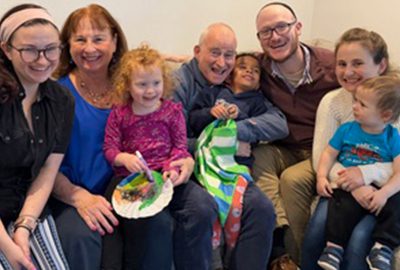
Sheryl and Eric, who have three grandchildren, including a five-and-a-half year-old granddaughter with special needs who lives nearby, describe the group as both practical and deeply personal.
“Some of us were struggling to varying degrees,” she said. “You’re watching friends talk about their neurotypical grandchildren and their milestones, and you realize your experience doesn’t match that.”
In the group, those comparisons are set aside. Instead, grandparents share resources, ideas and support.
“It definitely functions as a support group,” Sheryl said. “People bring creative solutions, but also just plain old support. A shoulder. An ear.”
The group includes grandparents with different family structures, levels of involvement and types of disabilities represented among their grandchildren. That diversity, Sheryl said, strengthens the conversation rather than complicating it.
“You get all these perspectives in one room,” she said. “And you realize there’s no single right way to do this.”
Jewish Values in Action
For Sheryl, the group reflects core Jewish values without needing to name them explicitly.
“We believe in taking care of each other,” she said. “We show up with dignity and respect. That’s very Jewish.”
At 68, Sheryl said she did not expect this volunteer role to bring something new into her own life.
“I didn’t really think I needed any more friends,” she said. “Turns out I was wrong.”
The relationships formed through the group have surprised her, offering connection at a stage of life when many people assume their circles are already set.
“This is a unique set of needs,” she said. “And having a place where you don’t have to explain yourself makes all the difference.”
Supporting the Parents, Too
One recurring theme in the group is helping their own adult children navigate parenthood under extraordinary pressure.
“A lot of what we talk about is how we can parent our adult children who are struggling to be parents,” Sheryl said.
For many grandparents, that support comes with emotional restraint. They want to help without overstepping, to offer advice without judgment and to show up consistently even when answers are elusive.
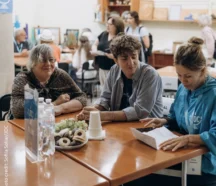
Those conversations unfold organically. Meetings often begin with a short D’var Torah connected to the weekly Torah portion or a Jewish text and then move wherever the group needs to go.
“There isn’t a formal agenda,” Sheryl said. “We have a little food, we talk and people share what they need to share.”
A Lifetime Shaped by Access and Inclusion
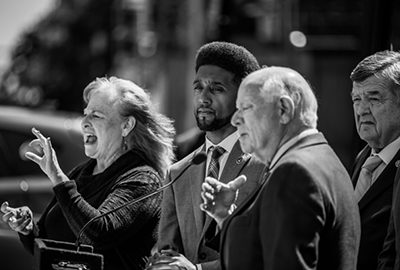
Sheryl brings decades of professional experience working with people with disabilities to her volunteer role. A freelance American Sign Language interpreter and former Towson University professor, she has spent her career advocating for access rather than sympathy.
“People with disabilities are just people,” she said. “They don’t want to be looked down on, and they don’t need pity. They need resources, support, accommodations and access.”
That philosophy shapes how she approaches the grandparents group. While she is deeply knowledgeable about deafness, she is careful not to position herself as an expert on anyone else’s experience.
“I come in with an open mind,” she said. “Each family’s situation is different. Each child’s disability is different. And each grandparent’s role is different.”
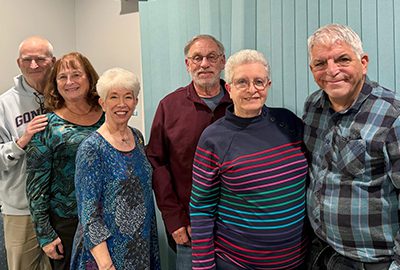
Each month, the group meets to share stories and explore topics like navigating family dynamics, strengthening the bond with grandchildren, supporting adult children and building a community of understanding and care.
Subscribe to our newsletter
The Associated is a home for everyone in the Baltimore Jewish community. We offer several email lists to help people find a community, engage with their peers and support Jewish journeys around the world.
Join Our Mailing List


Add Impact to Your Inbox
Sign up for our newsletter
Subscribe to our newsletter
The Associated is a home for everyone in the Baltimore Jewish community. We offer several email lists to help people find a community, engage with their peers and support Jewish journeys around the world.
Join Our Mailing List
 Please Wait while we loading your video.