Saving Jewish Lives and Building Jewish Life.
Reflections on our Global Work in the Former Soviet Union.
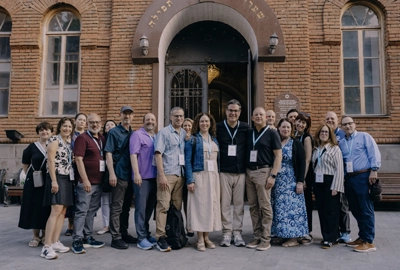
Traveling to see our work in Ukraine, Poland and Georgia with our partner, the American Jewish Joint Distribution Committee (JDC), alongside executives from other Jewish Federations, one phrase repeatedly came up: “Saving Jewish lives and building Jewish life.”
These simple words, expressing the intertwined nature of what we do in Baltimore and around the world, captured the extraordinary work taking place in these Jewish communities. While the circumstances in each country we visited were very different, with the ongoing conflict shaping daily life in Ukraine and the region, the mission was remarkably familiar.
Over four days, I had the privilege of speaking with recipients, hearing from professionals and seeing the impact of our partnership.
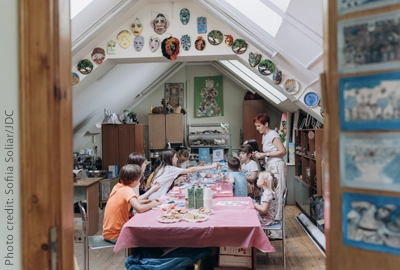
From Ukraine to Georgia
It’s hard to believe it’s been more than four years since the crisis in Ukraine began. Unfortunately, life has become even more dangerous for civilians, and, as a result, the needs continue to grow. We visited Lviv, a city located on the western part of Ukraine which fortunately has not experienced the same level of physical destruction as other parts of the country. Yet evidence of the crisis is everywhere, from soaring inflation to an influx of displaced persons.
Trauma is part of the daily lives of the residents. We met Suzy, who lives on the 25th floor of an apartment building in Kiev. Working at the JCC on the day her building was struck by a missile, she came home to a gaping hole on the 22nd floor. Yet, she continues to live there. There isn’t anywhere else to go.
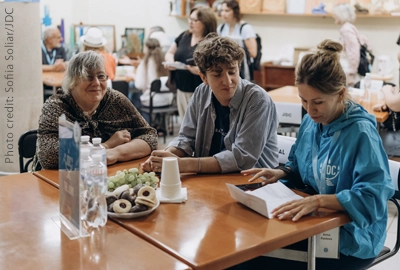
We stopped by the Chesed Trauma Center, supported by JDC. Located in the building’s basement, they feel reassuringly familiar to many Ukrainians, offering the same sense of security as a bomb shelter. There, people can seek support for the anxiety and uncertainty that have become part of their daily life.
Inna, who works for JDC in Ukraine, talked about the difficulty caring for others while living through her own truama. I’ll never forget her poigname remark, “I don’t want to be resilient. I just want to be human.”
When the conflict began, there were around 200,000 Jews in Ukraine; tens of thousands of Jews left to make aliyah or move to Europe. According to JDC, those that remain are “disproportionately the elderly, people with disabilites and thos struggling financially even before the ware.” Among the Jewish community’s greatest needs are food, medicine, utilities and psychological support. Our funding supports this.
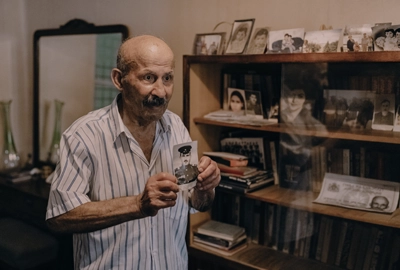
Meanwhile, in Georgia, one of the highlights of my trip was visiting Sholom, a 92-year-old gentleman who lived in the capital city of Tbilisi. Sholom shared stories of growing up poor when Georgia was part of the Soviet Union and reflected on the dramatic changes he has witnessed over the course of his life.
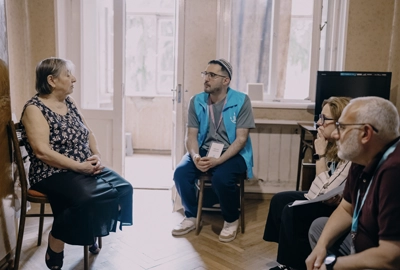
When the Soviet Union collapsed and Georgia gained its independence, life became incredibly difficult. Like many older adults, he barely survives on a small government pension that is simply not enough to meet his basic needs. For almost 30 years, thanks to the support of JDS and its Chesed Center, Sholom receives food, medical assistance, regular visits from a caregiver and essentials like heating during the cold winter months. I was deeply moved when Sholom spoke about his favorite holiday, Passover, along with his love for Israel and his pride in being Jewish.
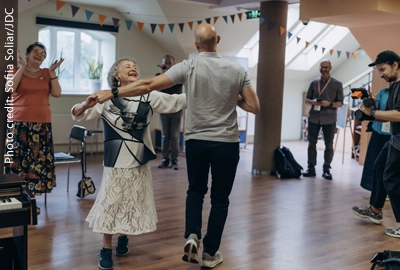
While in Tbilisi, we also witnessed the beauty of generations coming together to celebrate Jewish life. During a community gathering, a 9-year-old child sang Oseh Shalom; then, people of every age, from young children to older adults, rose to their feet and joined together to dance the hora.
The rebirth of Jewish life, coming after the horrors of the Holocaust and decades living under Soviet rule, where religion was suppressed, was a powerful reminder of how JDC is saving Jewish lives and building Jewish life.
Why Does it Matter?
Our commitment to supporting Jewish communities worldwide is a core part of our mission. Jewish communities cannot survive in isolation. That’s never been more apparent than today, as we confront rising antisemitism around the world, along with conflicts and economic hardships that threaten the well-being, security and continuity of the Jewish people.
What I witnessed was a powerful expression of Kol Yisrael arevim zeh bazeh, all Jews are responsible for one another. It is our commitment to not only help people through their most difficult moments and to ensure that Jewish life continues to be celebrated and passed on from generation to generation. Thanks to our generous supporters, we live these values every day.
Subscribe to our newsletter
The Associated is a home for everyone in the Baltimore Jewish community. We offer several email lists to help people find a community, engage with their peers and support Jewish journeys around the world.
Join Our Mailing List
Add Impact to Your Inbox
Sign up for our newsletter
Subscribe to our newsletter
The Associated is a home for everyone in the Baltimore Jewish community. We offer several email lists to help people find a community, engage with their peers and support Jewish journeys around the world.
Join Our Mailing List

 Please Wait while we loading your video.